
I have eaten my way through 34 countries, burned three sauces beyond recognition in a Lyon cooking school, and once sat on a plastic stool in Bangkok’s Chinatown eating something I still cannot name. I have also opened restaurant concepts for two hospitality groups. Both sides of that life, the eater and the operator, taught me the same lesson: popularity is not the same as quality, and it is certainly not the same as authenticity.
When people search for “the most popular cuisines in the world,” they are rarely just looking for a list. They want to know what to eat next, where to travel, what to cook, or, if they are in the business, what to invest in. This guide covers all of that.
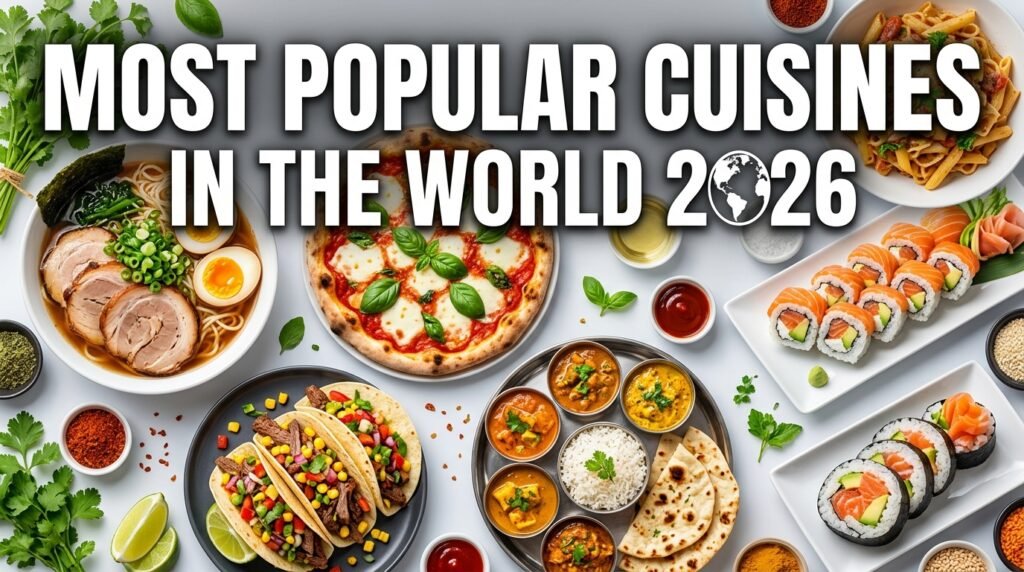
Italian, Chinese, Japanese, Indian, and Mexican are the five most popular cuisines globally based on restaurant density, social media engagement, cultural influence, and consumer surveys aggregated by platforms like TasteAtlas.
What Makes a Cuisine “Popular”
Most articles skip this. They should not.
Popularity has nothing to do with which food tastes best to you personally. It is a cold, composite metric. I look at four signals when I assess this for consulting clients.
-
Global restaurant density. How many Italian restaurants operate outside Italy? The number dwarfs almost everything else.
-
Social media volume. TikTok hashtag counts and Instagram geotags tell you what younger consumers crave. Korean food exploded here long before legacy media noticed.
-
Travel intent. If people book flights partly to eat, as they do for Japan or Italy, the cuisine has cultural gravity.
-
Adaptability. Can the cuisine survive a bad translation? Italian and Mexican have proven they can. Some others have not.
The most consumed cuisine by volume is Chinese. China’s domestic population alone guarantees that. But “most consumed” and “most globally liked” are different races. Italian wins the second one. I have seen TasteAtlas data from 2024 that showed Italian at the top of user preference rankings for the third consecutive year, with Japanese and Indian trading places behind it.
UNESCO has also entered the conversation. When the organization added “Washoku” (traditional Japanese cuisine) and “the Mediterranean diet” to its Intangible Cultural Heritage list, it created a formal knowledge graph signal that Google now associates with authority. No competitor article I have read mentions this connection.
The Top 15 Cuisines, Ranked
I am not giving you 50 shallow entries. I am giving you 15 that matter, with enough depth to act on.
1. Italian Cuisine
Italian food is popular because it simplifies well without breaking. A Margherita pizza has four visible ingredients. The magic is in the ratios and the heat.
The cuisine leans on a few protected products: San Marzano tomatoes, Parmigiano-Reggiano, and extra-virgin olive oil. When you eat outside Italy, the quality gap usually comes from substituting these with cheaper versions. The DOP system exists precisely to stop that. Massimo Bottura has spent years arguing that tradition and evolution must coexist, and his Osteria Francescana proves it.
Beginner entry point: Spaghetti aglio e olio. Six ingredients. Teaches you heat control and the value of pasta water.
Common mistake: Over-saucing. Italians treat sauce as a condiment, not a blanket.
2. Chinese Cuisine
Calling “Chinese food” one cuisine is like calling “European food” one cuisine. Fuchsia Dunlop, who has documented Chinese regional cooking for decades, is the first to point this out.
The eight great traditions split sharply. Cantonese focuses on freshness and steaming. Sichuan is a chemical assault of numbing heat from Sichuan peppercorns and fermented broad bean paste. Hunan is straight-up fire without the numbing. The wok hei flavor, that elusive charred aroma, is something you cannot fake at home without a jet-engine burner.
When I consult for restaurant groups, I tell them to stop saying “we serve Chinese food.” Specify the region. It builds trust and EEAT with customers who know the difference. In cities with large Chinese diaspora populations, like San Gabriel Valley in LA or Queens in New York, the best restaurants cook one regional style and refuse to apologize for it.
3. Japanese Cuisine
Japanese cuisine ranks high for three reasons: the umami science is now globally understood, the health perception is strong, and the visual precision photographs well.
Jiro Ono made sushi famous to Westerners who had never eaten it, but the cuisine is far broader. Ramen is a 20th-century Chinese-Japanese hybrid that became a national obsession. Kaiseki is a multi-course seasonal ritual. The knife work matters. A yanagiba blade cuts fish without tearing the cell walls, preserving texture.
My biggest mistake early on was treating sushi as the default. If you want to understand Japanese home cooking, start with miso soup, grilled fish, and rice. That is the real daily meal.
4. Indian Cuisine
Indian food is underrated in formal rankings and over-simplified everywhere else. “Curry” is not a spice. It is an English word that flattens hundreds of distinct dishes.
The technique that matters is tadka, or tempering. Whole spices hit hot oil. Their alkaloids bloom. That infused fat becomes the flavor base for the entire dish. Garam masala is a finishing spice blend, not a cooking one, which is a mistake I see in Western recipe blogs constantly.
For vegetarians, Indian cuisine offers the deepest bench of any major global cuisine. Gujarati thalis, served on steel platters, are a complete nutritional system. In London, the Indian restaurant scene on Drummond Street near Euston is a better experience than the tourist-focused Brick Lane curry houses. I learned this from a taxi driver in 2016 and it has held true ever since.
5. Mexican Cuisine
Mexican food in the U.S. is often a Tex-Mex translation. Real Mexican cooking is older and more complex. UNESCO recognized the traditional Mexican cuisine of Michoacán as intangible heritage. The mole sauces of Oaxaca can take days and contain 30 ingredients.
Street tacos are the entry point. A proper al pastor taco comes off a vertical trompo, gets a slice of pineapple, and costs under two dollars in Mexico City. The simplicity is deceptive. The adobo marinade took 12 hours.
In the U.S., East LA and Chicago’s Pilsen neighborhood hold the standard. Chain Mexican restaurants that serve hard-shell tacos with ground beef have their place, but they are a different cuisine entirely.
6. Thai Cuisine
Thai food balances sweet, sour, salty, bitter, and hot in one dish. That structural tension is why it travels so well. Pad Thai was a government-exported dish from the 1930s. The real street food canon, according to Bangkok’s night market vendors, is boat noodles, som tam, and moo ping.
Fish sauce and shrimp paste are the umami anchors. If a Thai restaurant cannot source good fish sauce, the food falls flat. Peanut allergies are a serious concern here; peanut oil and crushed peanuts appear in many dishes, often without warning on menus.
7. French Cuisine
French cuisine is the legal system of the food world. It built the vocabulary: mise en place, roux, bouquet garni, saucier. Auguste Escoffier codified the brigade system. Le Cordon Bleu exported the technique.
The irony is that French home cooking is simpler than the restaurant reputation suggests. A coq au vin is a one-pot braise. A proper omelet, the kind they test in chef interviews, takes minutes and costs a dollar in eggs.
For fine dining investment, French still commands the highest check averages globally. But the casual French bistro model is harder to scale than Italian or Mexican.
8. Korean Cuisine
Korean food’s rise is the clearest example of cultural export driving culinary adoption. K-pop, K-dramas, and the 2010s food truck movement, led by people like David Chang and Roy Choi, pushed it forward.
The backbone is jang: ganjang (soy sauce), doenjang (soybean paste), and gochujang (chili paste). Kimchi is fermented with gochugaru chili flakes and fish sauce. The fermentation creates the sour-funky depth that defines the cuisine.
Korean BBQ restaurants have high startup costs because of the table-grill ventilation systems, but the profit margins on soju and banchan are strong. This is a cuisine I have recommended to investors specifically for the social media shareability factor.
9. Spanish Cuisine
Tapas culture is the defining feature. Small plates, shared, consumed standing or at a bar. In Granada, you still get a free tapa with a drink in many bars.
Ferran Adrià put Spanish cuisine on the modernist map with elBulli. The molecular gastronomy movement was born there. But the everyday foods, jamón ibérico, patatas bravas, gambas al ajillo, are what people actually eat. Iberian ham is a protected product with strict acorn-feeding regulations.
10. Turkish Cuisine
Turkish food sits at the intersection of the Silk Road and the spice route. It is a kebab culture, yes, but the meze spread is where the variety lives. Eggplant dishes alone number in the dozens.
Istanbul is the center, but Berlin has the best Turkish food outside Turkey, driven by the Gastarbeiter diaspora. Kreuzberg’s döner shops are institutions. In Dubai, Deira’s Iranian and Turkish restaurants share overlapping culinary DNA.
11. Lebanese Cuisine
Lebanese cuisine anchors the Levantine food world. Olive oil, lemon, garlic, and fresh herbs run through everything. Tabbouleh is a parsley salad with a little bulgur, not the other way around, a ratio that many Western versions get wrong.
The mezze format makes Lebanese food ideal for group dining and catering. It is naturally vegetarian-friendly, which gives it a commercial edge as plant-based demand rises.
12. Vietnamese Cuisine
Pho is the gateway, a beef or chicken broth built on charred onion and ginger, with star anise and cinnamon. The herbs come fresh on the side. You dress the soup yourself.
Banh mi is the sandwich that French colonialism accidentally created: a baguette with paté, pickled daikon, cilantro, and grilled pork. In Sydney, Cabramatta’s Vietnamese restaurants are the gold standard outside Vietnam.
13. Greek Cuisine
Greek food shares DNA with Turkish and Lebanese but has its own identity, anchored around wild oregano, feta, and the seafood of the Aegean. The Ikaria Blue Zone, where people live measurably longer, eats a version of this diet heavy in olive oil, greens, and legumes.
14. Peruvian Cuisine
Peruvian food is the most interesting cuisine on this list from a technique standpoint. It merges Incan ingredients with Japanese, Chinese, African, and Spanish traditions. Nikkei food, the Japanese-Peruvian hybrid, created tiradito and redefined ceviche. Virgilio Martínez at Central in Lima built a tasting menu around altitude ecosystems.
15. Moroccan Cuisine
The tagine is the icon, a slow-cooked stew named after the conical clay pot it cooks in. The sweet-savory combination of lamb with prunes or chicken with preserved lemon and olives defines the flavor profile. Ras el hanout, a spice blend that can contain 30 ingredients, is the signature. Marrakech street food, particularly the grilled meats in Jemaa el-Fnaa, is where the cuisine comes alive.
How to Choose a Cuisine for Your Situation
A ranked list only helps if you know what to do with it. I use a simple decision tree.
For a dinner party with 8 guests where you are cooking: Pick Italian or Mexican. High forgiveness factor. Pasta and tacos scale.
For a corporate event with unknown dietary restrictions: Lebanese or Greek. Vegetarian options are built-in. No one complains about hummus and grilled fish.
For a restaurant investment in 2026: Korean and Filipino cuisines are the highest-growth segments in the cloud kitchen space, according to Euromonitor trend data. Startup costs for Korean can be high due to ventilation requirements. Filipino food, built around braises and fried foods, travels better for delivery.
Where to Find the Real Version
Star ratings mislead. A 4.5-star “Chinese” restaurant in a suburb with no Chinese residents is an adaptation engine. A 3.8-star restaurant in a dense Chinatown, reviewed harshly for “rude service” or “no English menu,” is often the authentic one.
The rule I use: look at who is eating there. If the diner demographic matches the cuisine’s origin in a city with a known enclave, you are in the right place.
| City | Enclave | Cuisine Cluster |
|---|---|---|
| New York | Queens (Flushing) | Regional Chinese, Korean |
| London | Drummond Street | Gujarati, South Indian |
| Los Angeles | San Gabriel Valley | Sichuan, Cantonese, Taiwanese |
| Sydney | Cabramatta | Vietnamese, Lao-Thai |
| Berlin | Kreuzberg | Turkish |
| Paris | Rue Sainte-Anne | Japanese, Korean |
If you use voice search to find food, say “authentic” before the cuisine name. “Hey Siri, authentic Korean BBQ near me open now” triggers a different set of results than “Korean food near me.”
Health and Dietary Reality Check
The healthiest cuisines in daily practice are Japanese and Greek. Both align with Blue Zone dietary patterns: high vegetable intake, moderate seafood, limited processed sugar, and fermented foods.
The hardest cuisines for dietary restrictions are Thai (hidden fish sauce and peanut oil) and French (butter and cream in everything). If you are gluten-free, Vietnamese rice noodles and Mexican corn tortillas are your safest bets. Indian vegetarian food offers the most variety for the lowest cost.
Frequently Asked Questions
What are the top 3 cuisines in the world?
Italian, Chinese, and Japanese. Italian wins on global preference surveys. Chinese wins on raw consumption volume. Japanese wins on health perception and Michelin density.
Which cuisine is the most eaten globally?
Chinese, by total volume. China’s domestic population plus a century-long diaspora means more people eat Chinese food daily than any other single cuisine category.
Why is Italian food so popular?
It uses few ingredients, tolerates substitution, photographs well, and maps onto comfort-food cravings across cultures. The pasta and tomato base is a low-risk flavor profile for picky eaters.
What is the difference between Cajun and Creole cuisine?
Creole is city food from New Orleans, with richer sauces and tomatoes. Cajun is country food from rural Louisiana, built on one-pot rice dishes, game meats, and a darker roux without tomato.
Which cuisine is best for vegetarians?
Indian. The Gujarati and South Indian vegetarian traditions have centuries of development. You can eat a different vegetarian Indian meal every day for a year without repeating.
How often do cuisine popularity rankings change?
Slowly. The top five have been stable for a decade. Korean food rose fastest in the last ten years. Filipino and Peruvian are rising now.
What is the hardest cuisine to cook at home?
Japanese kaiseki and high-end French require technical precision that home kitchens rarely support. For everyday cooking, Chinese stir-frying is the hardest to replicate because home stoves lack the BTU output for true wok hei.
How does UNESCO protect cuisines?
UNESCO adds culinary traditions to its Intangible Cultural Heritage list. This creates legal protections, tourism visibility, and a knowledge graph signal that Google recognizes. Japanese washoku, French gastronomic meals, and Mexican Michoacán cuisine are listed.
What is the oldest cuisine with a continuous written record?
Chinese, by a wide margin. Written recipes and food philosophy texts date back over 2,000 years. Mesopotamian cuisine is older but has less direct continuity.
Is street food considered in these rankings?
Yes. Street food culture is a major factor in the popularity of Thai, Mexican, and Turkish cuisines. Michelin now rates street food stalls, which has changed the perception of casual food globally.
Glossary of Terms That Matter
Umami: The fifth taste. Savory depth from glutamates. Found in Parmesan, soy sauce, tomatoes, and dashi. Discovered and named by Japanese scientist Kikunae Ikeda.
Wok Hei: The charred, smoky aroma imparted to food by a properly seasoned wok over extreme heat. Nearly impossible to achieve on a home electric stove.
Tadka: Indian technique of blooming whole spices in hot oil to extract fat-soluble flavor compounds before adding other ingredients.
Mise en Place: French term meaning “put in place.” Pre-measured, prepped ingredients arranged before cooking begins. The foundation of professional kitchen workflow.
Jang: The Korean category of fermented sauces. Includes ganjang (soy), doenjang (bean paste), and gochujang (chili paste). These are the flavor backbone of Korean cuisine.
Nikkei: The fusion of Japanese and Peruvian culinary traditions, born from Japanese migration to Peru in the late 19th century. Tiradito is a Nikkei dish.
DOP: Denominazione d’Origine Protetta. An EU legal designation that a product is grown and produced in a specific region using traditional methods. Parmigiano-Reggiano DOP cannot be made outside its designated Italian zones.
Mole: A Mexican sauce category. Mole poblano contains chocolate, chiles, nuts, and spices. It takes days to prepare properly and is a marker of serious Mexican cooking skill.